Sunday, May 15, 2011

Denis Olivier

Denis Olivier is a French photographer who does amazing film photographs of landscapes, people and objects. His long exposures of landscapes are magical, and the contrast and quality of the film really add to his style.
Olivier comes from a very artistic background, both his parents were artists and he was interested in painting and sculpture from a young age, eventually getting into photography and studying art at university. In his website bio he talks about how his photographic background began:

"My first encounter with photography took place when my parents performed some strange static dances with an object in front of their face. Later they would close themselves up in a special room under the house for long periods of time, and no one was allowed in. They diligently made sure that they were left to their own devices while inside. One day I was given permission to enter the room and allowed to stay, but on the condition that I didn't move or went out. I remember there was a unique chemical perfume and a red light.
I was bewildered: my parents appeared flashing a white light on a piece of paper using a strange apparatus. Then they dipped it into a clear liquid and Behold! I couldn't believe it, a miracle! They were wizards who created pictures."

I really love the way he talks about his parents photography, it captures the magic of the old film days so beautifully, and adds a touching child-like innocence to his story.

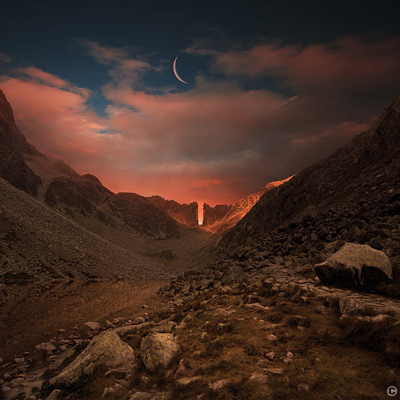
 My favourite works of his are his surreal compositions; his work is in my eyes the definition of 'surreal'. His series is called 'Dreamspace' and includes around 50 composites.
I really love Olivier's style, and his dream like images have a very magical aura to them. There is something about them being film like that makes them appear more surreal, as there is little to no hint of photoshop.


Check out his website for more amazing images, he has a huge range of genres: http://www.denisolivier.com/
He also has a range of interesting interviews, which can be found at his site, one of my favs is this one: http://www.nd-magazine.com/denisolivier/index.php

Thursday, May 12, 2011

Abstract, Conceptual and Surreal Photography

The differences between abstract, conceptual and surreal photography are often hard to define, as in many cases images can include qualities of each genre. Although digital artworks often get confused over which genre they belong, abstract, surreal and conceptual photography are all different and have their own key elements and principles.
There is a fine line between conceptual and surreal photography, as sometimes it is hard to tell if the meaning behind the image was intended or not; the general rule is if the idea for the image was planned and has a clear and understandable meaning, then it is conceptual, but if there is no apparent meaning and the image portrays elements in an unrecognizable way, then it is surreal.

Abstract Photography


Abstract photography focuses on patterns, and is often taken in a very minimalist way. The image is free of concept and idea, which allows you to focus more on the texture, form and colour of the image. Abstract images are generally straight shots, but often use in camera techniques such as long exposures, shallow depth of field or macro to capture a part of the world we do not generally see.


Conceptual Photography
Conceptual photography is an image that is formulated off an idea or story, and the original concept is much more important than the image that portrays it. A prime example is advertising photography; where the image is trying to sell the 'idea' of the product. As conceptual photography is predominantly used in advertising, it is often taken in a clean, crisp and vibrant style, which may or may not be photoshopped. On general principle conceptual images blend and combine recognizable objects to create humorous or interesting compositions that have very distinct messages. Conceptual photography tends to get mixed up with surreal photography when the concept isn't believable or clear.


Surreal Photography
Surreal photography is defined as 'dreamlike' and portrays things that we wouldn't be able to see outside the realms of our subconscious mind. The meaning behind surreal artworks is left in the eyes of the viewer, as there isn't a specific concept that is depicted. Many surreal artists never have set ideas for their work, they just let the work transform as they create it. Photomanipulation is almost a necessity of surreal photography, as in order to be surreal, it has to not be something that could be seen in real life; textures and filters are often used to give a grungy, desaturated look, to give hint that the image is of something that is 'out of this world'.


Friday, March 25, 2011

Report Methodology

In order to create my report I intend on posting regular blogs, and keeping them organized so at the end I can create my report using previous entries, this will be extremely helpful as a lot of blog entries are about 'in the moment' feelings, which can be hard to remember if you are doing it all at the end. The kind of blog entries I intend on doing are:

Section 1 - Folio Development

  • Respond to brief and plan out ideas, including all of the shots I will need and possible locations
  • Create mood boards for composites to display my ideas and intended style
  • Write about the techniques I used to create my composites, and post 'in progress' material to make sure I am on track
  • Post any tutorials I refer to and use for my Photoshop work
  • After the composites are finished write a summary and a critique of my work
  • Comment on where I want my work to take me after CIT

Section 2 - Context
  • Post a blog on any photographers I find inspiring and talk about them and there work
  • Also post any music / stories /  events I find inspirational to my ideas

Section 3 - Industry
  • Talk about my findings after researching other photographers; what styles are effective and how they achieve them, how they find work etc
  • Research my chosen field further, and learn the best ways to get work as a photographer and digital artist
  • Contact other photographers and agencies to find out more information
  • Report on any photographers contacted, and anything I learn from workshops

Thursday, March 10, 2011

Surreal Photography

Things I have learnt so far:

  • Combining common inanimate objects to create a surreal image is very compelling as people see these objects all of the time, so when they are put out of context they can seem very strange and interesting Surrealism as a visual movement had found a method: to expose psychological truth by stripping ordinary objects of their normal significance, in order to create a compelling image that was beyond ordinary formal organization, in order to evoke empathy from the viewer. - taken from wikipedia
  • Square crop Vignette really is the way to go
  • In order to be a good Surreal photographer you have to be European
  • Overlaying textures is a good way to enhance a surreal image
  • A very desaturated, one tone look helps blend the image together
  • You can't plan surreal photography - in order to create an effective a surreal image it has to come from the subconscious, so is therefore rarely planned out. 
  • The aim of Surrealism is to evoke emotion in the viewer

Wednesday, March 9, 2011

Sarolta Bán

Sarolta Ban is a surreal photographer from Budapest, Hungary. She does amazing photomanipulations by combining ordinary elements to create a dreamlike fantasy. There isn't much I can say about surreal photography, as more often than not the interpretation is up to the individual viewer. Here is what she had to say about her work:

"I like using ordinary elements and by combining them, I can give them various stories, personalities. I hope that the meanings of my pictures are never too limited, are open in some way, each viewer can transform them into a personal aspect. So I’m happy if different people find different meanings in my images."


Tuesday, March 8, 2011

Semester Plan

This is the brief I was given for this semesters work:
  • Produce a series of 6 fantasy based location composite images that include people shot in the studio
  • Select 5 existing advertising campaigns and create a composite photograph for each that could be used in the campaign, the product and therefore the campaign is completely up to you
  • Produce a series of 4 magazine front cover portraits that use constructed composite backgrounds in the style of the painting, the Mona Lisa
  • Submit at least 1 recorded step by step compositing process - a tutorial of the compositing process for that final image

6 Fantasy Composites
For my fantasy composites I plan to challenge the perceptions of reality. I want my images to convey strong emotions, and have characteristics of a dreamlike state. I will be adopting a surrealist style for my composites, and draw upon photomanipulation artists such as Luis Beltran and Michal Karcz for inspiration (see below for examples). For these composites I intend on shooting the landscapes first, and the studio portraits second. As all of my landscapes will be shot using natural lighting, I have no control over where the light falls, In the studio however I can manipulate the light to match that of the landscapes, therefore making my composites more seamless.
The shot lists only include the major images I need - most of my composites will include many little aspects and artificial elements.

1. City Nightscape
This composite will be of a man looking over a city at night, with a dramatic starry sky with planets. I plan to paint the sky using Photoshop. This is one of my ideas I intend on building on a lot, as I dont have a solid idea of how I want it to look, and I want it to be original.

Shots I need:
  • Man
  • City - I plan to do nightshots of Sydney, Melbourne and Canberra and use parts of each.


2. The Room
For this image I want to turn a photograph of a rainforest into the walls of a room. I plan to include a window, in which there will be a desert scene. There will also be someone in the room, but what they will be doing is currently undetermined. 

Shots I need:
  • Rainforest - I plan to go up to the Dorrigo rainforest near Coffs Harbour.
  • Desert - Perry sand dunes near Mildura
  • Person
  • Wooden floor


3. Oasis
This composite will be of someone riding a horse through the desert towards an oasis.

Shots I will need:
  • Desert - Taken at the Perry sand dunes near Mildura.
  • Tree and pond
  • Person
  • Horse

4. Leap
The idea for this one is to make it look like someone is leaping off a cliff. I was thinking about adding wings to the person, but I think this might make it look a bit too cliche. I was originally thinking of having a person sitting on the cliff, but thought it would be much more dramatic if I had them jumping.

Shots I will need:
  • Cliff and landscape - I intend to shoot these at the Grampians National Park in Victoria, this way I wont need separate shots for the cliff and the landscape
  • Woman - jumping with long hair and long flowing dress

5. Abduction
This composite will be of a UFO abduction. I plan to have a house, (which I will shoot at night and light up with a speedlight, and also use the speedlight to create a light spot where the tractor beam will be) and a girl holding a teddy bear being beamed up by an alien spaceship.

Shots I will need:
  • House - I plan to do this at Orroral homestead, as a real house would be too cluttered and I will have more control over the homestead as it is not owned by anyone.
  • Girl - Holding teddy bear and levitating
  • UFO - I obviously can't take a picture of a UFO, but I will be painting this in in Photoshop using other artworks and models for reference

6. Wizard
I haven't finalized my idea for this composite yet, but I want to have a wizard in a mountainous area performing a spell of some kind. It will most likely have a dark style to it and the spell will be painted in in photoshop.

Shots I will need:
  • Wizard - Old man in a grey cloak
  • Mountains - I will see what I get out of the Grampians National Park and decide if I need to shoot elsewhere. I will most likely end up merging multiple landscape shots together


4 Magazine Covers
For my magazine covers I have chosen 4 different personalities / professions that I can link appropriate backgrounds to. I will be shooting all of my portraits waist up or head and shoulders, as the focus of magazine covers is on the persons face. For this series it doesn't matter if the portrait is shot before the landscapes, as I will not be 'inserting' them into the landscape, merely placing them on top.

1. Zoologist
My first composite is of a zoo keeper or zoologist, so the portrait is going to be someone dressed in khaki with animals behind him.

2. Clown
My second magazine cover is going to be of a clown. It will be an older man with his face painted and a clown suit, with circus tents, a ferris wheel, balloons etc in the background.

3. Pirate
Another composite is of a pirate, with an ocean, islands and his ship in the background.

4. Noblewoman
My final magazine cover is of a noble woman, most likely set in the 1800s, with extravagant clothing. In the background will be luscious gardens, a pond and a gazebo.


5 Advertisement Campaigns
My final 5 composites are of advertisement campaigns. I have to choose 5 existing campaigns and plan a composite that will fit the campaign. With most of the campaigns I will be shooting the landscapes first and then the portraits. With the product campaigns however it doesn't matter if I shoot the products first as the lighting on products is always perfect.

1.L'Occitane
My first product composite will be reasonably simple. I will just take a photo of a product in the studio and make a pretty background out of a nice sky and flowers.

2. Panasonic 3D TV
This composite is based on a graphically drawn advertisement, but I will obviously be using photography. The concept is that the TV is so realistic that the character escapes out of the TV, and the person is telling it to get back in. As I am a beginner in Photoshop painting my character will be of human form, most likely a Spartan warrior.

3. Subaru
Again the car in this advertisement is a 3D rendering,  but I will be taking a photograph in the studio. The tagline of this ad is 'Performance Enhanced' and pictures a horse that has been modified to be better. I will be doing a similar thing by modifying a person with computer, car and speaker parts. I am yet to decide on the location.

4. Spring Valley
This advertisement is of juice where a beautiful oasis is sits on top. I will need to combine different photos of trees and water to make it look like it does in the advertisements.

5. Campari
This is my favourite campaign of the 5 I have chosen. There are 12 images in this series all depicting characters from famous fairy tales. The image portrays powerful women figures with a bottle of campari, and often half naked men pining over them. I will be doing a composite of Rapunzel, and have her sitting in a tower with a campari cocktail and a bottle sitting on the sill. A man will be waiting below. I will be painting most of the hair in Photoshop.


Images from: (in order)

Monday, March 7, 2011

Michal Karcz

Michal Karcz is a Polish photographer and digital artist who does amazing surreal landscapes. Originally a painter, Michal has turned to photography and digital software to create realities that are unobtainable through regular dark room techniques.
Michael gets his work by doing cover art for authors and musicians, and has clients throughout Europe and the USA. I really love his work as it is very surreal, yet so realistic, and you can really feel the emotions behind his work.
Michal Karcz is possibly my biggest idol at the moment, as I would love to do the work he does, and I find it absolutely breathtaking the way he can capture such beauty in his art. I would also love to be able to do cover artworks like he does.
I had a very hard time picking example images for my blog as his website has hundreds of amazing pieces, I highly suggest you all check him out!


I always try to make an extraordinary picture and my goal is to make a viewer stop for a minute, to influence on emotions and take away from reality. Am I making it happen?. appraise yourself.
Michal Karcz